
How to Scan on iPhone
Your iPhone already has a perfectly capable document scanner built in — Apple just hid it in three different places and didn't tell anyone. Here are the three ways to find it, plus the point where a dedicated scanner app actually starts to earn its keep.
Method 1: The Notes app (the easiest one)
The fastest way to scan something on iPhone uses an app you already have on the home screen. It works on every iPhone running iOS 13 or newer — which is everything from the iPhone 6s forward.
- Open the Notes app and tap the compose button to start a new note.
- Tap the camera icon above the keyboard.
- Choose Scan Documents.
- Hold your phone over the document. iOS detects the edges of the page (yellow overlay) and auto-captures when it has a clean shot — or tap the shutter to grab it manually.
- Adjust the crop corners if needed, then tap Keep Scan. Repeat for additional pages.
- When done, tap Save. The scan attaches to your note as a multi-page PDF.
To share or export as a standalone file: tap the saved scan in the note, then the share button → Save to Files, Mail, Messages, or wherever.
Pro move: auto vs manual capture
Tap "Auto" in the top-right corner of the camera screen to switch to "Manual." Auto-capture is great when the document has clear contrast against the surface; manual is better for low-contrast pages or when you want to take your time framing.
Method 2: The Files app
iOS 13+ also exposes the same scanner from inside the Files app. Useful when you want the scan to land directly in a specific folder — iCloud Drive, an SMB share, OneDrive, Dropbox — without going through Notes first.
- Open the Files app.
- Navigate to the folder where you want the scan to live.
- Tap the ••• menu in the top-right and choose Scan Documents.
- Capture pages the same way as in Notes.
- Tap Save. The PDF lands in that folder, ready to share or sync.
Method 3: The Mail app (scan straight into an email)
If your endgame is "send this document to someone right now," you can scan from inside a Mail draft and skip the save-then-attach step.
- Open Mail and start a new message.
- Long-press the body of the email until the formatting toolbar appears.
- Tap the > arrow until you see Scan Document.
- Capture pages, tap Save, and the PDF attaches itself directly to the draft.
All three methods use the same engine
Notes, Files, and Mail are all calling the same iOS API (Apple's VisionKit). The output is identical — same edge detection, same perspective correction, same image quality. Which one you start from is just about where you want the file to land.
What the built-in scanner does well
- Edge detection and auto-crop — iOS finds the page corners and snaps the frame.
- Perspective correction — even at an angle, the output looks like a flatbed scan.
- Color, grayscale, B&W, and photo filters — accessible via the three-circles icon after capture.
- Multi-page PDF — pages stitch together automatically.
- Live Text — on iOS 15+, you can long-press text inside a scanned image and copy it (limited OCR, no searchable PDF).
What the built-in scanner doesn't do
This is where most people start looking for an app. The built-in scanner is genuinely good for one-off documents, but it stops cold at these:
| Capability | Notes / Files / Mail | Scaniva |
|---|---|---|
| One-off scan | Yes | Yes |
| Multi-page PDF | Yes | Yes |
| Searchable PDF (real OCR) | No* | Yes — 14 languages |
| Compress to fit email/upload limits | No | ~80% smaller |
| Receipt / business card / ID modes | No | Yes |
| Merge separate scans into one PDF | No | Yes |
| Organized library | Inside notes/folders | Dedicated library |
| Password-protect PDFs | No | Yes |
*Live Text lets you copy from an image, but the scan is still an image PDF — text isn't searchable, and screen readers can't read it.
When the built-in scanner is enough
If you scan once a month — a receipt for an expense report, a permission slip, a contract — Notes is fine. Don't install anything. The built-in scanner does the job, the PDF goes where it needs to go, and you're done in under a minute.
When you'll want a real scanner app
Three triggers usually push people past the built-in scanner:
- Searchable scans. You're filing receipts, contracts, or research papers you might need to find again. Without OCR, every scan is a black box — you have to remember the date and folder you put it in.
- Big files that won't send. A 10-page color scan from iOS Notes can hit 25–40 MB. Gmail caps attachments at 25 MB; many government upload forms cap at 5 MB. You need compression.
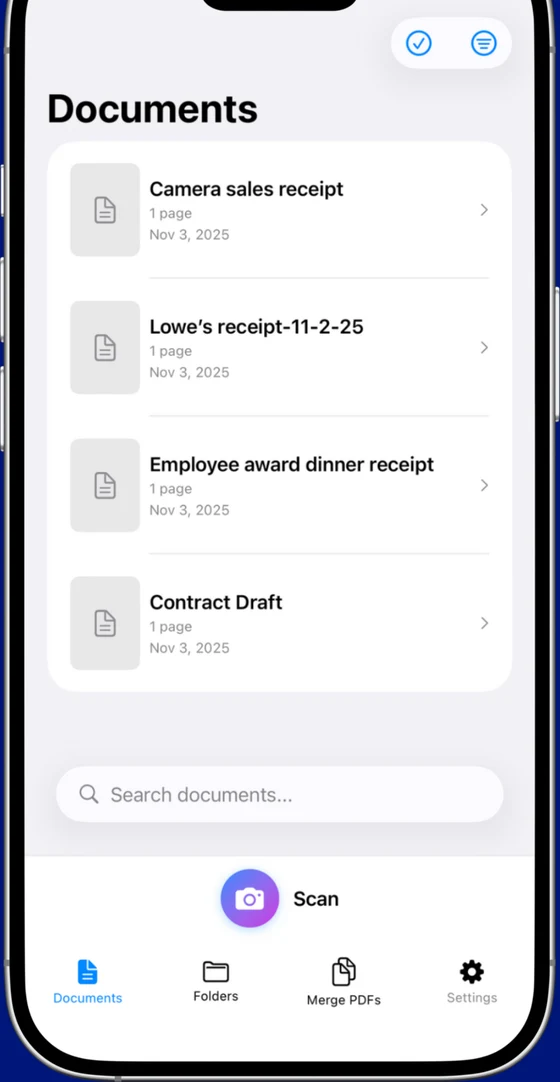
- Volume. Once you're scanning more than a few documents a week, the Notes-app workflow (open Notes → new note → camera → scan → save → share → delete the empty note) starts feeling like friction. A scanner app opens directly to the camera.
What to look for in a scanner app
If you decide to install one, four things actually matter — the rest is marketing:
- OCR, in your languages. A "free" tier without OCR (looking at Genius Scan) means image-only PDFs. Make sure OCR is there, and make sure your languages are supported.
- No forced account. CamScanner, Microsoft Lens, and Adobe Scan all require sign-in before you can use the camera. That's a real friction point for casual use.
- One-time pricing exists. The category has drifted heavily toward $4.99/week subscriptions. If you'd rather pay once and own it, the option is rarer than it used to be — but it exists.
- Offline. If the app requires a network connection to scan, OCR, or export — it's uploading your documents. Local-only apps don't.
Scaniva — when the Notes app stops being enough
Real OCR in 14 languages, ~80% PDF compression, batch scanning, no account, no subscription. Free tier with 10 scans to start, $12.99 one-time to unlock unlimited.
Download on the App StoreFAQ
Does iPhone have a built-in scanner?
Yes — since iOS 13. It's available inside the Notes, Files, and Mail apps. There's no standalone "Scanner" app on the home screen, which is why most people don't realize the feature is already there.
How do I scan a document on iPhone without an app?
Open the Notes app, create a new note, tap the camera icon above the keyboard, and choose "Scan Documents." That's it — no third-party install required.
Why does my scan look crooked?
The auto-crop sometimes guesses wrong, especially on low-contrast surfaces. After capture, tap a corner of the yellow overlay and drag it to the actual edge of the page, then tap "Keep Scan." iOS straightens it from there.
Can I make a scan searchable on iPhone?
Not with the built-in tools. Live Text (iOS 15+) lets you long-press inside a scan to copy text, but the saved PDF is still an image. For a genuinely searchable PDF — where you can ⌘F a word or feed it to a contract reader — you need a scanner app with OCR.
Where does iPhone save scanned documents?
Notes scans live inside the note that you scanned from. Files scans save to whichever folder you started from (iCloud Drive, On My iPhone, or a connected cloud service). Neither shows up in the Photos app.
Why is my scanned PDF so big?
iOS Notes saves scans at full resolution with no compression, so a 10-page color scan can easily be 30+ MB. To shrink it, you need a tool that re-encodes the images — iOS doesn't ship one. Scanner apps with built-in compression typically cut file size by 70–85% while keeping the text legible.
Is the iPhone scanner any good?
Yes — surprisingly so. Apple's VisionKit is the same engine used by most third-party scanner apps under the hood. The image quality is excellent; what's missing is everything around the scan (OCR, library, compression, batch workflows).