Bulk File Merger Help
How to merge Excel, CSV and text files, use the merge options and Find and Replace, and fix common problems.
This page describes version 6.1 for Windows and Mac. The version number is at the bottom of the app window; to update, choose Help > Check for updates.
Merge files
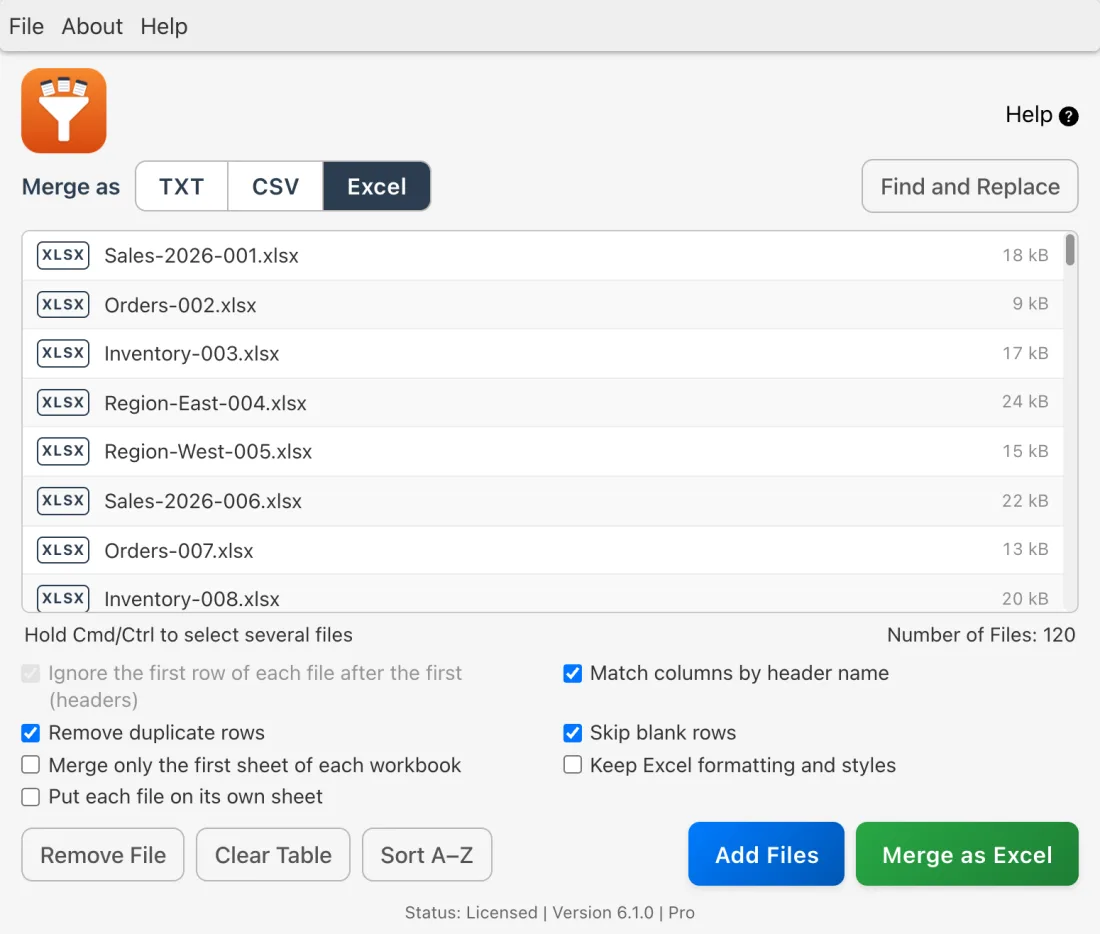
- Add your files. Drag files or a whole folder into the window, or click Add Files. Bulk File Merger takes .xlsx, .xls, .csv and .txt files and skips anything else, including the temporary files Excel keeps while a workbook is open (names starting with ~$).
- Choose the merged file's type next to Merge as: TXT, CSV or Excel.
- Put the files in order. Drag them up or down the list, or click Sort A–Z. Hold Cmd (Mac) or Ctrl (Windows) to select several files; Remove File takes the selected files out of the list and Clear Table empties it.
- Tick the options you need under the list (see Merge options).
- Click Merge as Excel (or CSV, or TXT), choose a name and a folder for the merged file, and save. When it is done, the app shows how many files and rows were merged; click Open the merged file to see it.
Your own files are never changed: the merge always writes a new file.
Merge options
The options shown depend on the type you merge as. They start unticked each time you open the app, except Skip blank rows and lines, as noted below.
| Option | What it does | Merges |
|---|---|---|
| Ignore the first row of each file after the first (headers) | Keeps the header row of the first file only, so the merged file has one header. | TXT, CSV, Excel |
| Match columns by header name | Reads each file's first row as its column names. The merged file gets one header with every name, and each value goes under its own name, so files whose columns are in another order, or that lack some, line up. Names match whatever their upper or lower case. Ticking it also ignores the repeated header rows. | TXT, CSV, Excel |
| Remove duplicate rows | Leaves out every row that repeats one already merged. | TXT, CSV, Excel |
| Skip blank lines (Skip blank rows for Excel) | Leaves out empty lines and rows, including rows of spaces or of empty fields. Ticked to start with for CSV and Excel, unticked for TXT. | TXT, CSV, Excel |
| Add a column with each file's name | Adds a column saying which file each row came from. | TXT, CSV |
| Merge only the first sheet of each workbook | Takes the first sheet of each workbook and ignores the others. | Excel |
| Keep Excel formatting and styles | Keeps each workbook's formatting and styles in the merged file. | Excel |
| Put each file on its own sheet | Makes one workbook with a sheet for each file, each kept whole. The header, matching, duplicate and blank-row options don't apply then. | Excel |
Files from different sources. A CSV merge writes one separator: if your files use different ones (comma and semicolon), the others are converted. Text in different encodings or languages comes out as one file that opens correctly in Excel.
Find and Replace
Change a word, a name or a code in many files at once: Excel (.xlsx and .xls), CSV and text.
- To work on some files only, select them in the list. Otherwise every file in the list is searched.
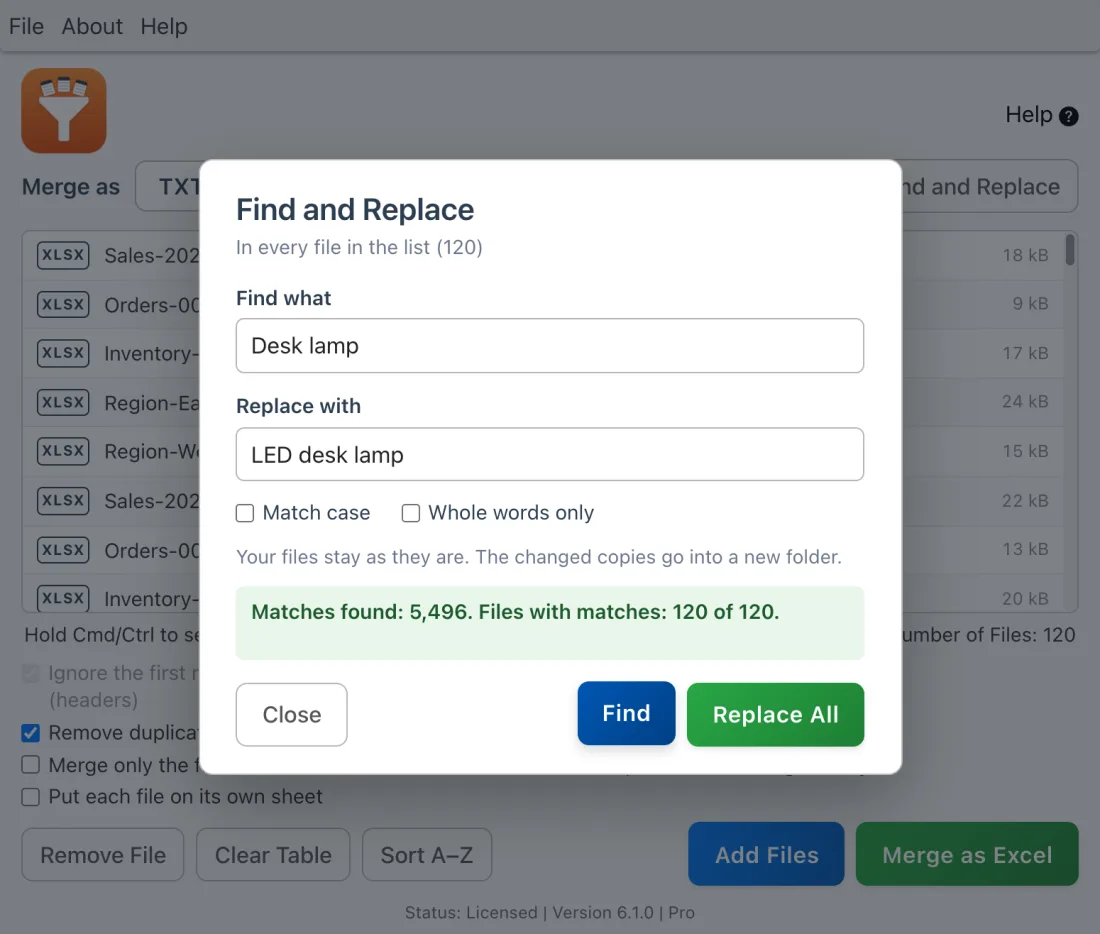
- Click Find and Replace at the top right. Type what to find and what to replace it with. Tick Match case or Whole words only if you need them.
- Click Find to count the matches and the files that have them. Nothing is changed.
- Click Replace All and choose where the copies go. The app makes a new folder there, "Modified Files", with a changed copy of each file that has a match, named like "Sales (modified).xlsx". Files without a match get no copy, and your own files stay as they are.
Good to know
- In workbooks only the text in cells changes. Numbers, dates and formulas are left alone, and so are the heading rows of Excel tables, which Excel needs to stay as they are. A pivot table shows the old text until you refresh it in Excel.
- Very old .xls files (Excel 95 and earlier) can be searched but not changed. Save them as .xlsx first.
- Text and CSV copies keep the file's encoding and line endings.
- Replace All is part of the Pro version; a Basic license can use Find. The free trial includes Replace All, and each copy it writes counts as one of your free files.
License key
- Enter your key: choose About > Enter License Key... and paste the key from your order email. More help on the license activation page.
- Moving to another computer: choose Help > Reset License Key... (or use the reset page), then enter the key on the new computer. A key can be reset only a few times.
- Basic or Pro: Basic merges Excel workbooks; Pro merges Excel, CSV and text files and includes Replace All. If you bought Basic and need Pro, enter the new Pro key in the same menu. See the plans.
- Free version: a number of files merge in full; after that, each file is merged as a preview of its first rows. The bottom of the window shows how many free files are left.
- The app checks the license online. Without internet it stays licensed for a while and tells you how many days are left.
Troubleshooting
A file was left out of the merge. The merge goes on with the other files, and the message at the end names the files left out and why:
- Password-protected: open it in Excel, remove the password, save it, then merge again.
- Not an Excel workbook: the file has an .xlsx name but is something else, such as a CSV or a web page saved from another program. Open it in Excel and save it as a workbook.
- Empty, damaged, or no longer in its folder: check the file, or add it again.
An update error every time the app opens (Windows, version 5.x). Older 5.x versions can't install the current updates themselves. Download the latest version and install it; if it asks for your license key, enter it again.
Large merges. A merged Excel file is always an .xlsx workbook, which holds up to 1,048,576 rows per sheet. For more rows, merge as CSV, or put each file on its own sheet.
System requirements. Windows 10 or 11, or macOS 13 or later.
For further assistance, please contact us.